|
1. The 2nd SS-Panzer Division "Das Reich"
- 6th of june - moved to Normandie
Towards the end of 1943 the 2nd SS-Panzer
(Armoured) Division, 'Das Reich', was moved from Russia
to southern France so that they could be re-equipped and re-trained.
The chief in command was the SS General Lammerding. One of Das Reich's young officers was Adolf Diekmann who had been severely
wounded fighting the French in 1940. He had been shot through the lung
and had spent several years as an instructor on light duties at the
SS-officer training school at Bad Tölz, before going to Russia in the
autumn of 1943. Another officer was Diekmann's friend Helmut Kämpfe,
who had spent several years in Russia and had recently won the Knights
Cross (Germany's highest award) for his bravery in halting a Russian
tank attack.
When the invasion began on 6th June
1944, the 2nd SS Panzer Division 'Das Reich'
(15,000 men aboard 1,400 vehicles, including 209 tanks) under the
command of SS General Lammerding, was ordered to move north to
Normandy to help the rest of the German army repel the allies and
throw them back into the sea. As soon as the SS began to move north
they were attacked by the Resistance. At every step along the way
they were ambushed and shot at. The Resistance could not do much
serious damage to Das Reich, but they could and did irritate the
troops a great deal, in the same way that midges can spoil a picnic.
To avoid these actions the Germans were hardly intreseted to find
the cached arsenals of arms of the resistance.
2. 8th June :The FTP lost the battle
against the SS Division "Das Reich".
The attacks of the Resistance, mainly
from the FTP, continued and then on the 8th of June the FTP resistance
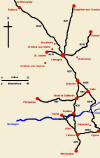
tried to liberate the town of Tulle, 70 km south of Limoges, from
the occupying German garrison. In the battle that followed, the FTP
came close to capturing all the German troops of the local garnison, but before they could
quite finish the job, that evening Das Reich arrived to the rescue.
The SS made short work of the undisciplined and poorly armed Resistance
fighters, who were soon in full retreat. They found 40 dead bodies of
the German 3rd Battalion/95th Security Regiment local garrison troops near
the school, their bodies badly mutilated. Other bodies were found around
the town, bringing the total German dead in Tulle to sixty-four.
3. 9th June
Reprisals in Tulle
Next
day, the reprisals began. The SS general Lammerding ordered that 120
civilians should be executed. The officer Aurel Kowtsch with help
of Heinrich Wulf and Walter Schmald will execute this order, while
Lammmerding moved allready to Limoges. First the male people will be
assembled with the help of the Milice in the court yard of the munition factory to select this
120 man for execution. On demand of the prefect Pierre Trouillé 1400
of the 2000 man where liberated . The selection of 120 man was then
made , taking by preference the oldest and unic sons of the
families. The executions started in the afternoon. Ropes
has to be delivered by the inhabitants of Tulle. They were hung up
with the help of the Milice on lamp-posts and from
balconies along the "Place de Soulhiac and the nearby streets.
The inhabitants were rassembled at the place de Soulhiac to
look at this massacre as a warning against further actions from the
FTP. 500 of these inhabitants were taken as hostages, from them 250
send to to Dachau. Because, short of ropes only 99 man were
executed. The feelings
of the population of Tulle were probably divided, about the amateuristic
action of the communist FTP who lead to the killing of their compatriots.
Till now (2012) this massacre is not mentionned in the touristic brochures
of the city.
4. 9th
June The Ftp continue to attack the
german army, which arrived the 9th of June around Limoges.
What happened in Tulle was a
severe warning against the resistance,. Nevertheless the communistic
FTP continued the same 9th of june their actions which will lead to
a even bigger desastre. The division "Das Reich"had been
attacked underway through the FTP and falled in an embuscade near
Combeauvert. The 31 resistants ware captured, shot and their bodies
overriden with tanks. After that they found on their way to limoges
the empty car of Major Kämpfe, who will be killed by the
resistance. He was a close friend of Lammerding and Diekmann. A
search started immediately to find not only Kämpfe but also arsenals
of arms. Nothing was found and it was only in the evening
that Karl Gerlach could give somme information. He was captured
through the FTP resistance, but could escape and said that a
captured SS officer and an arsenal of arms of the resistance were
present in the same village, unknowing the name of the
village. Although without further information it has been
concluded by the Germans and the Milice that the officer was Kämpfe
and this village was
Oradour-sur-Glane where one should find an arsenal of arms of the
resistance. The same day the SS Division "Das
Reich" arrived at Limoges, a town famous for its porcelain. In
the small town, of St. Julien (30 kilometres north from Limoges) the
'Der Führer Regiment' was regrouping. The commanding officer
of the 1st Battalion of this SS Regiment was the thirty-two year old
SS Sturmbannführer Adolf Diekmann, a survivor of the Russian front.
5. 10th June. The tragedy at Oradour-sur-Glane.
Just this section of commander Adolf
Diekmann (together with Otto Kahn and Heinz Barth) was send to the socalled resistance centre of Oradour-sur-Glane
to free the way to Normandy. The soldiers arrived
10th June at 2 o'clock in the afternoon. It has never been cleared out
if this was at the beginning an action to kill all the people or just
an action taking hostages and under the command of Diekman, under influence
of the loosing of his friend Kämpfe, has resulted into a
massacre. It has been said that the Diekman asked first for hostages
but that the mayor (F: maire, Nl: burgemeester) refused and that the
comander Diekman could n't reach his superiors by phone for
instructions. Maybe being without further orders this troop with
their Russian experience did it on their Russian way. Whatever
allmost all the inhabitants were killed, woman and children
burned in the church and the men shot down in six barns.
It was said that the massacre started with an explosion of muntion
in the churrch just behind the altar. Two version are circulating:
this explosion was done by the Germans or by the resistance who
cached munition in the church and tried to escape with this
explosion. We know
that only Marguerite Rouffanche could escape through a window behind
the altar. As a result of this tragedy the maquis finished
their actions and the SS division could without further resistance
move to Normandy. But the
atrocity of this action was judged exagerated by the German Army and
a martial trial was prepared against Adolf Diekmann. In between Adolf
Diekmann was send with his division to Normandy, where he was later
killed in action in the Normandy battle area on the 29th of June and
in the given circonstances no further action for a martial trial was
taken.
6. Bordeaux 1953. Trial..
After the war 21 soldiers of the division
"Das Reich" were send to trial in Bordeaux in 1953. Seven of them were
German soldiers yet in captivity, 14 others came from Elsace and ware
living there in liberty. And this was the weak point of the trial:
because the people in command, who ordered this action like Diekmann
and Lammerding were not present, so the defence argued that the soldiers
and certainly the Elsacian soldiers could do nothing to defeat this
action in order to be killed themselve. They could be condamned to death.
The reaction in Alsace was violent. They said that they were incorporated
involuntary in these SS Division, out of their will: "Malgré Nous" as
they said. Some were comdamned to death. But we should understand that
at that time the politicians were not interested in a broader discussion
of this drama which could divise the Elsacian society or criticise the
role of the other parties involved like the communist resistance. So
the Elsacian soldiers were then shortly after the trial liberated
to restore the national unity as was said and the rest was free by
1959.
~~~~~~~~~~~~~~~~~~~~~~~~~~~~~~~~~~
It's clear that the outcome of this
trial has leaved the relatives of the victims unsatisfied. Even the
conservation of Oradour as a symbol against this kind of atrocities
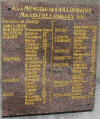
or the rename of Charly to Charly Oradour in memory of the Lorrain
victims could only partly milder the pain they feel.
~~~~~~~~~~~~~~~~~~~~~~~~~~~~~~~~~~
References
The
official French website for Oradour, it has an English section.
-Ref 1. Centre
de la Mémoire.
I took my information mainly from the website of Michael
Williams:
michael@oradour.info
-Ref 2. Oradour-sur-Glane
10th June 1944
He mentions following interesting links:
-Ref 3. Oradour-sur-Glane.
This site is in French (and occasionally English), it is very heavily
based on the book, Oradour-sur Glane a vision of horror (see Bibliography).
-Ref 4.
The tragedy which
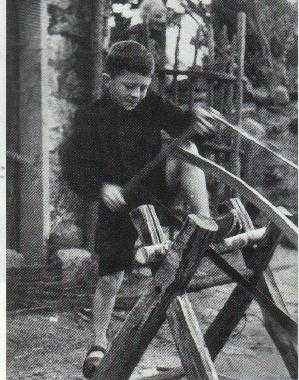
struck Oradour. See there the little Roger Godfrin from Charly,
aged eight, escaped from
the massacre of Oradour-surGlane
A second very important link is the website: "Scrapbookpages.com"
:
-Ref 5.
http://www.scrapbookpages.com/Oradour-sur-Glane/
: It gives us pictures and the various versions about the tragedy of
Oradour-sur-Glane.
- There we find a discussion in relation to the folowing
websit, considered as revisionist: -Ref 6.
AAARGH website. This site gives a review of the evidence offered
at the trial in Bordeaux in 1953. This website says that there were
a lot of resistants in Oradour-sur-glane and that with the arrival of
the german troops some hided themselves in the church. In attempt to
force a breakout they did explose the munition hidden in the church.
In the confusion that followed started the tragedy of Oradour-sur-Glane.
|